
The Thinking Needs Room
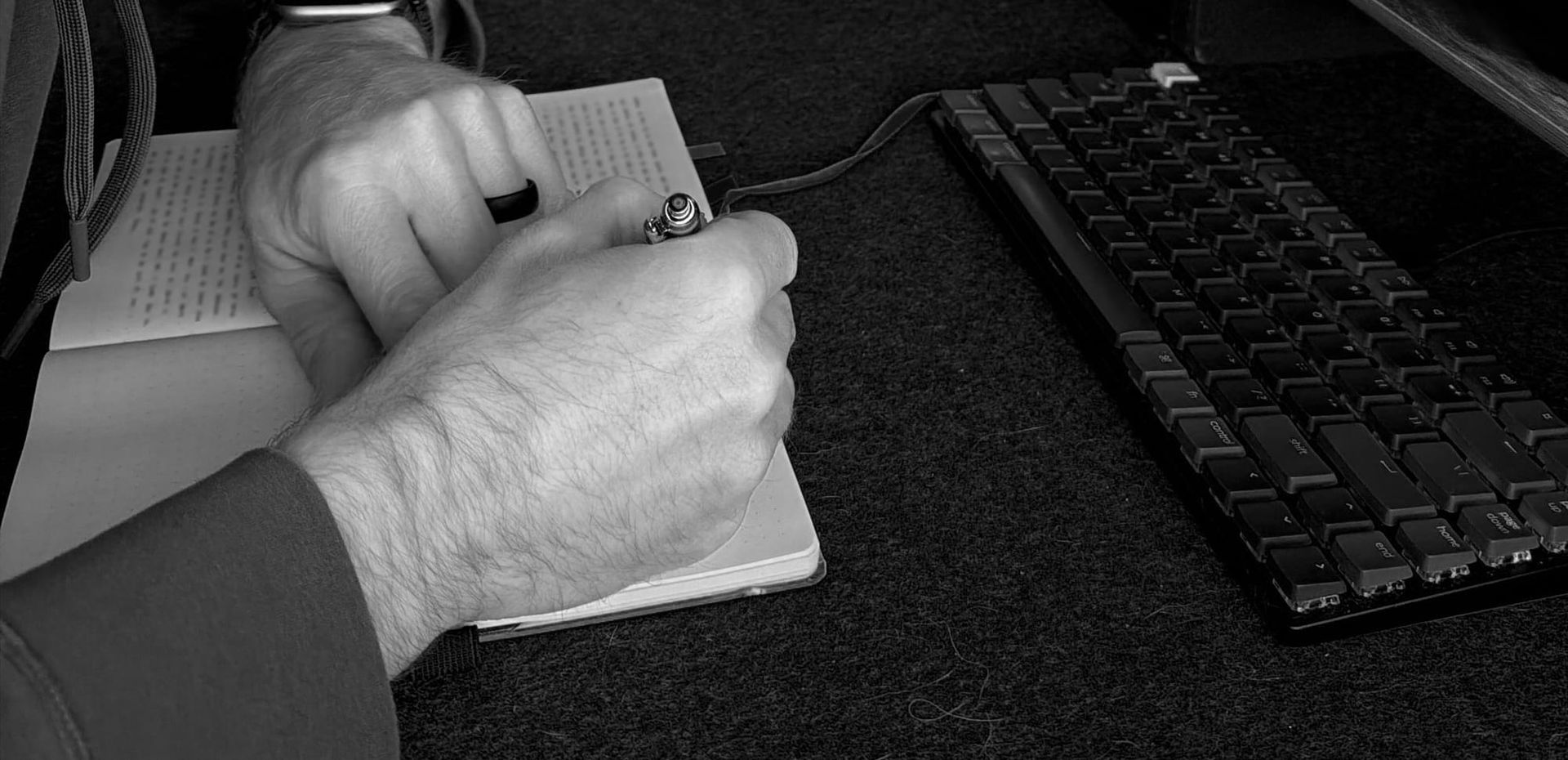
On parallel thinking, permanence, and the clarity we build with our hands
We taped a giant roll of brown paper across an entire wall for a journey mapping exercise during a workshop. Incidentally, our client had procured the roll from a nearby BBQ vendor and it made the room smell like brisket, but while that added a unique flavor to the workshop, I doubt that was the key ingredient. By the second hour, sticky notes covered it edge to edge. Nobody was waiting for a turn. Someone would post a note near the onboarding section while someone else worked the renewal end of the map, and within a few minutes you'd see a cluster start to form somewhere neither of them expected. Nobody planned those clusters. They just showed up, because the wall let them. And around those clusters conversations naturally emerged.
I've facilitated a lot of workshops over the years. This one produced a level of alignment I don't see often, and it happened fast. Stakeholders who usually needed multiple rounds of follow-up meetings to land on a shared picture were pointing at the same cluster of notes by lunch, arguing about the same three problems instead of talking past each other about five different ones. Notes were added, perspectives aligned.
I keep coming back to why that workshop in that room worked so well, and I don't think it was the paper itself. It was what the paper let people do.
Nobody was waiting on a cursor. Nobody got the "someone else is editing this" message. Two people could work opposite corners of the map at the same time, and a third could walk up, take in the whole thing at a glance, and drag six notes into a new group because a pattern had just become visible to them. That doesn't happen at the same speed on a screen. Even the good digital whiteboard tools, and I use them, still hand you a canvas you scroll through, a zoom level you fight with, some queue of who's allowed to touch what and when. Virtual meetings have a single conversation, with maybe a fragmented secondary one in the chat. Breakout rooms further fragment the conversations. The tools have a process, and they want you to comply with it. Paper is much more permissive. It just holds whatever you put on it, wherever you put it, for as long as you leave it there.
This last part mattered more than I gave it credit for at the time.
A few months later, on a different project, we printed our research findings as posters and hung them around the workshop room. Each poster was dedicated to an overarching theme, each one carrying a short summary and a few direct quotes from our interviews. I used the poster to present my findings to kick off the workshop and expected people to glance at them once at the start and forget they existed. Instead, participants spent the whole day pointing at them. Someone would push back on an idea and a colleague would gesture across the room. "That contradicts the poster in the corner." By the afternoon the posters weren't decoration anymore. They were part of how people argued with each other.
Slides don't do that. Once you advance, the previous point is gone, remembered only by the select few who happened to be paying close attention when it flashed by. Digital whiteboards aren't much better. Scroll to a different section and the thing you were building ten minutes ago is out of frame and, functionally, out of mind. The paper stayed up. The posters stayed on the wall. They didn't have to get out of the way for the next thing. Their physical persistence encouraged a mental persistence for the participants in the room.
I explored this in a recent piece: the friction we're usually so eager to design away is sometimes the exact thing that makes people pay attention. This felt like another version of that. The slowness of moving a physical note, the effort of walking across a room to check a poster instead of glancing at a tab, wasn't a cost anyone paid. It was doing something. It bought the group's attention and held it there a little longer than a click would have. It made it stick.
And the artifact was never really the point. The wall of sticky notes, the posters in the corner, neither one was what people walked away with. What they walked away with was the clarity they'd built themselves, with their own hands, in front of each other. Nobody handed them a synthesized summary slide and asked them to trust it. They made the clusters. They noticed the contradiction. They worked through the tension. It's hard to argue with a pattern we built ourselves. It’s not about the artifact, but about the clarity and conviction it helped shape.
None of this makes me anti-digital, and I'd be lying if I said I don't reach for a shared doc or a digital board with gusto. Remote teams need them. Documentation needs them. Scale needs them, and there's no world where I'm printing posters for a stakeholder group spread across four time zones.
But I've started noticing how often a tool's default process quietly inserts itself too prominently into my process. And I think this is especially problematic in the moments where the whole point is for a group to think something through together, not just produce an artifact at the end of it. I didn't choose the tool because it served the thinking. I chose it because it was already open on the laptop. We need to make sure we are asking the right questions, not just the ones that are part of a tool or a template.
So I keep asking myself, in workshops and everywhere else: what have we let creep into our process just because it was the easiest thing already sitting in front of us? What would we create differently, and maybe understand more deeply, if we let ourselves take up the whole room instead?